
Haircut numbers explained: a clipper guard size chart
When a barber asks “what number?”, they mean the clipper guard: the plastic attachment that snaps onto the clippers and sets how much hair is left behind. Learn the numbers once and you can ask for the exact same cut in any shop.
Each haircut number is a clipper guard size. The higher the number, the longer the hair: a #1 leaves about 3 mm (1/8 inch), each step up adds roughly 3 mm, and a #8 leaves about 25 mm (1 inch).
Clipper guard size chart
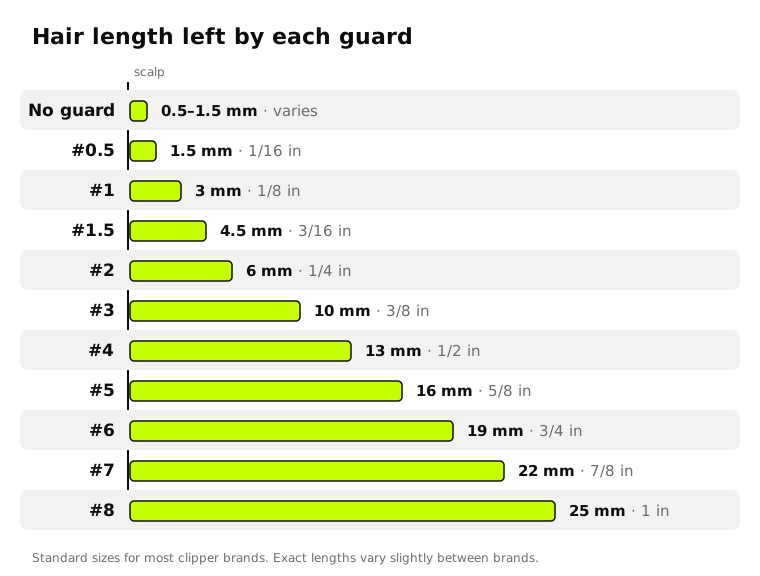
| Guard | Length | What it looks like |
|---|---|---|
| No guard | 0.5 to 1.5 mmvaries | Almost skin. Used for skin fades and sharp outlines. |
| #0.5 | 1.5 mm1/16 in | Very close. The scalp is clearly visible. |
| #1 | 3 mm1/8 in | A short buzz. Plenty of scalp still shows through. |
| #1.5 | 4.5 mm3/16 in | A half size between a 1 and a 2. |
| #2 | 6 mm1/4 in | Classic short back and sides. The scalp is mostly covered. |
| #3 | 10 mm3/8 in | Short and neat, with full scalp coverage. |
| #4 | 13 mm1/2 in | A medium buzz with a bit of brushable texture. |
| #5 | 16 mm5/8 in | Short, with noticeable thickness on the sides. |
| #6 | 19 mm3/4 in | Long enough for the hair to lie flat. |
| #7 | 22 mm7/8 in | Just shy of an inch. |
| #8 | 25 mm1 in | The longest standard guard. Anything longer is usually cut with scissors. |
Half sizes and the clipper lever
Most clippers have a small thumb lever on the side. Flipping it open drops the blade back slightly to leave a fraction more length, which is how barbers get half sizes like a #1.5 and buff out the line between two guards. If you want something in between two numbers, just ask for a half grade.
How numbers make a taper or a fade
Barbers rarely use just one guard on a cut. Instead, they step through a few numbers so the hair blends smoothly from short to long:
- A taper only blends the hair down at the neckline and around the ears. It looks sharp and grows out cleanly without needing a visit every two weeks.
- A fade blends the hair all the way around the sides and back, often dropping down to bare skin or a #0.5 at the bottom.
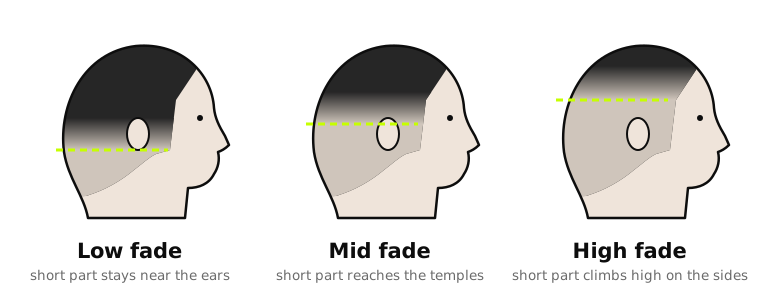
Barbers usually talk about fades as a range. Asking for a “skin fade up to a 3” means bare skin at the bottom, blended up into a #3 near the top of the sides. The height of a fade is how far up the short section goes: a low fade stays just above the ears and neckline, a mid fade reaches around the temples, and a high fade climbs to near the top of the sides, where the head starts to curve.
What to say to your barber
Buzz cut: Could I get a number 3 all over, please?
Short back and sides: A number 2 on the back and sides, tapered at the neck, and take a bit off the top with scissors so it sits around 2 inches.
Mid fade: A mid skin fade up to a 3 on the sides, and leave around 3 inches on top with some texture.
For the top, give a rough length in inches or centimetres (or show with your fingers), and ask for scissors unless you want the same number all over. Standard guard sets stop at 1 inch.
One caution: brands differ slightly
The chart above covers standard Wahl and Andis guard sizes, which are widely used in barbershops. A few brands label their guards in millimetres instead, or run a millimetre shorter or longer. If you're visiting a new barber and aren't sure, ask them to start one guard higher than you think you need. You can always ask them to take it down a grade, but you can't put it back on.
Bring a picture as well as a number
Numbers only tell your barber the length on the sides, not the shape of the haircut. Two people can ask for “a 2 on the sides” and walk out with completely different cuts depending on how high the blend goes and how the crown and fringe are shaped. A photo removes the guesswork. FADR lets you test the cut on your own face first, and gives you barber notes for the styles you try, so you can show them what you're after.
See any cut on your own face
Take a selfie and try hairstyles in seconds. No account needed.
More guides
Types of fades: low, mid and high, taper, skin and more
Every type of fade explained with diagrams: low, mid and high fades, taper vs fade, skin, drop, burst and temple fades, and what to ask for.
How to know if a haircut will suit you before you cut it
Face shape, hair type and upkeep decide whether a haircut suits you. Here's how to check each one, with real before-and-after results.